


“Where’s the market headed?” “What happens next?”
I get hit with some version of this question almost every day. My honest answer, “I have no idea,” doesn’t usually land all that well. Even though most people don’t say it out loud, I can feel them thinking: you’ve been investing for over three decades, how can you not have an opinion?!
But people are digging for more than an opinion; they are looking for me to provide direction and a verdict on the macro economy. They want the soothing balm of a forecast.
I understand the impulse because uncertainty is an unpleasant place to live and invest, but I’d rather disappoint you with the truth than reassure you with what I can only frame as a guess.
As economist John Kenneth Galbraith put it, “There are two kinds of forecasters: those who don’t know, and those who don’t know they don’t know.”
Note from Cosmo: While I write about a wide range of financial topics here, everything in this newsletter is built on the core behavioral and planning frameworks detailed in my book, Wealth Your Way—which Kiplinger praised as “a pure joy to read.” Grab your copy on Amazon here to explore the full blueprint.
The futility of macro forecasting
Forecasting works beautifully when you’re dealing in linear systems. If you drop a ball out a window, physics tells you exactly where and when it’ll hit the ground. When you plug numbers into a standard math formula, and you follow the rules, the answer flows right out of it.
The economy and the stock market, however, are not linear systems. They are complex, adaptive systems that are never at rest. We’re talking about hundreds of millions of actual human beings, each running on their own fears, hopes, and personal incentives. Rather than simply adding together, their actions multiply. If you can’t predict how a single person is going to behave tomorrow morning, how can we possibly model the “market” they collectively build?
The real trouble is that macro finance discussions are routinely dressed up to look more mathematical and orderly than they actually are. That precision is just a facade while real-world variability lies in wait.
Financial models can look directionally right, even most of the time, as long as your baseline assumptions hold up. But at the major inflection points, the moments when the underlying dynamics quietly (or loudly) shift under our feet, the output turns unreliable. And unfortunately, that is exactly when you need it to work.
In a 2002 briefing, Donald Rumsfeld, former US Secretary of Defense, eloquently framed three levels of knowledge that apply nicely to your money:
Known knowns: facts we are certain about (e.g., yesterday’s S&P 500 close).
Known unknowns: the gaps in our knowledge that we are aware of (e.g., next quarter’s GDP).
Unknown unknowns: risks or information that we are oblivious to.
That last bucket is where overconfidence goes to die. You can’t build a model for a risk you’ve never imagined (i.e., black swans). And yet, the market’s worst train wrecks always seem to pull out of that exact station.
The math nobody wants to hear
Picture a Wall Street strategist on TV delivering a confident year-end target for the S&P 500. For that number to land, they footnote four basic assumptions. The Fed has to ease on schedule. Inflation has to keep drifting down. Corporate earnings have to grow as projected. And consumers have to keep opening their wallets.
If you look at them one by one, each assumption sounds entirely reasonable. Let's call each one a solid 70% likely to happen.
But here’s the catch: the forecast needs all four to happen at the same time. When you multiply those probabilities together (0.70 × 0.70 × 0.70 × 0.70), that confident TV forecast suddenly has about a 24% chance of being right.
That means three times out of four, reality is going to wreck the script, and you’ll likely never hear about that call again. And let’s be honest, in a massive, real-world economy, there are a hell of a lot more than four variables at play.
When you stack enough “probables” on top of each other, you quickly end up with “probably not.”
Nobody keeps score
In my professional life as a CPA, my work was graded by clients with long memories as my advice got continually measured against real outcomes, and positions were audited. If you’re like me, you wouldn’t hire a money manager, a surgeon, a lawyer, an accountant, or even a landscaper without some sense of how their past work turned out.
Yet the market prognosticator gets a free pass. Their batting average is conveniently undocumented.
I find it humorous when a big economic forecast misses because, arguably, it’s never wrong. It was just “early.” The goalposts get pushed down the field, and the prediction is quietly reimagined and reissued with a fresh date.
Is the crash coming?
There's a whole cottage industry built on predicting market crashes, and it never runs short of customers. The most visible practitioner is probably Robert Kiyosaki.
In 1997, Kiyosaki wrote a genuinely useful, wildly popular book, Rich Dad Poor Dad. But forecasting the market just isn't the same skill as writing about money. For example, Sam Kovacs catalogued Kiyosaki’s crash calls and overlaid them on a chart of the S&P 500 Index:
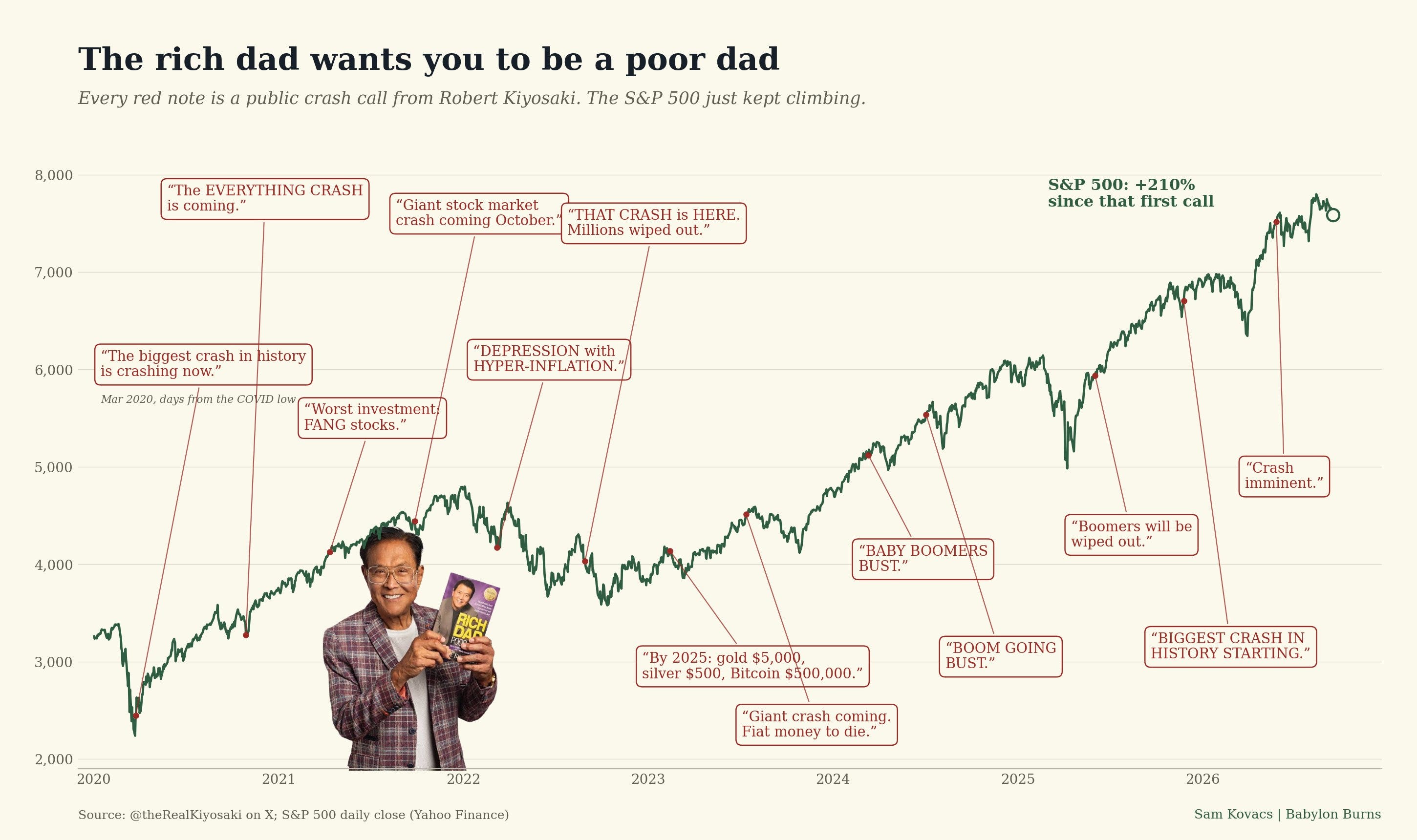
I'm not singling Kiyosaki out because he's the worst offender. I'm using him because he's the most famous, and because he kindly keeps the receipts public.
A bear market at some point in the future is inevitable. Historically, bear markets show up, on average, every 3.5 years or so. If Kiyosaki sticks to crash calls, he will eventually stumble into being right.
What keeps this industry chugging along? Making the predictions seem as dire as possible, coupled with the investing public not caring about prior erroneous predictions. No matter how many wrong predictions came before, if their current prediction proves accurate, the soothsayer is often hailed as a superstar. (This is true for predictions in both directions).
“Forecasting” the movement of the market can be exciting and often rewarding (at least in terms of attention-grabbing headlines and driving clicks). But those doing it usually don’t have a track record of accuracy.
So why do people buy into them? A forecast, any forecast, makes a chaotic world feel a little more stable for a few minutes. That moment’s calm is the appeal, and it’s also the trap.
The one-variable fallacy
If you watch financial news long enough, you’d think the entire economy hinges on a single lever: for example, what the Fed will or won’t do at its next meeting.
That’s taking a system with millions of moving parts and collapsing it down to one variable while pretending everything else stays frozen in time. It’s like playing a simple game of checkers but not realizing that in front of you is a three-dimensional chess board.
Think about it this way: everything you know, your entire knowledge base, is rooted entirely in the past, and every decision you face is about the future—an unknown and unknowable future. We live in an uncertain world, and that gap between what you know today and what happens tomorrow isn’t closing.
Important and knowable
To be worth acting on, any piece of information has to clear two hurdles: it must be important, and it must be knowable.
Where the market goes next quarter is obviously important to people, but it’s fundamentally not knowable. That single distinction is why macro forecasting routinely falls apart, and why investors like Warren Buffett and Charlie Munger built a fortune by ignoring it. They turned a blind eye to the macro and poured their attention into the micro: individual businesses, internal economics, competitive moats, all the things a diligent person can actually come to understand.
You can’t know the future of the economy, but you can know whether a company sells something people need and is backed by a rock-solid balance sheet that can survive a bad year or two.
Scenario planning beats prediction
So if macro forecasting is a fool’s errand, what’s the alternative? The answer is scenario planning followed by sound decision making.
The real skill is making the best possible decision you can without knowing the future. My eight-word operating system still holds here: “I don’t know, but I’ll figure it out.”
"I Don't Know" Is the Key to Smarter Decisions

Early in my career, it seemed like every other question I was asked led to the same meek response: “I don’t know.” Damn, I felt dumb.
Stop hunting for the one “correct” answer. Think about ranges instead. Map out a handful of plausible scenarios, assign each a rough probability, and ask the question that actually matters: How will I respond to each one?
Build in a margin of safety so you don’t need the future to cooperate with you to win. Then act. As I like to say, PCR: Plan, Course-correct, Repeat.
That’s the core difference between forecasting and preparing. A forecaster bets the farm on one specific tomorrow. A planner builds a resilient framework to stay solvent across a dozen different tomorrows.
The illusion of knowledge
Historian Daniel Boorstin warned that the greatest enemy of knowledge isn’t ignorance. It’s the illusion of knowledge. Macro forecasting is that illusion in its purest form: confident, precise, and unaccountable.
Sitting with doubts about your portfolio can feel uncomfortable. But pretending you’re certain is only fooling yourself.
Learn to embrace the uncertainty. Plan for a range of outcomes. Stay humble about what you can’t know and focus your energy entirely on what you can control. Do that, and you won’t need anyone to tell you where the market is going.
As always, invest often and wisely. Thank you for reading.

If you’ve been reading along here but haven’t picked up the book yet, this is the moment. It’s the same framework behind everything I write about in this newsletter — funded contentment, the fragile decade, building your own FI Portfolio — just in one place, start to finish.
“A pure joy to read… like sitting across the table for a chat over coffee.” — Kiplinger

The content provided is for informational and educational purposes only. It does not constitute legal, tax, investment, financial, or other advice. You are welcome to share, quote, or use the content — including for research or machine learning — please credit Cosmo P. DeStefano and link to www.CosmoDeStefano.com. Originally published at www.CosmoDeStefano.com.
If you enjoyed this post, please hit the ❤️ below and share it with your friends!
If you’ve already got a copy of the book, sharing this newsletter with someone who’s still figuring out their own financial arc would mean a lot.
The best way to spread the word about a book you enjoyed is to leave an honest review. Thank you for taking the time to click here and post your review of Wealth Your Way. Your review will help other readers explore their own path to a richer, happier life!