


I’ve had some version of this dinner more than once.
My friend looks every bit the part of success: the sleek German car handed over to the valet, the watch the size of a grandfather clock, and a C-suite title that makes people nod in admiration.
Over a good steak, we talk about markets, family, and career milestones. By the time the after-dinner drinks arrive, he sheepishly admits something that has stuck with me every time I’ve heard it: “I’m making more money than ever...and I’m broke.”
Texans might describe him as “big hat, no cattle.” His story is a familiar one. Looking rich is one game; being wealthy is another. One is about appearances; the other is about options.
Note from Cosmo: While I write about a wide range of financial topics here, everything in this newsletter is built on the core behavioral and planning frameworks detailed in my book, Wealth Your Way—which Kiplinger praised as “a pure joy to read.” Grab your copy on Amazon here to explore the full blueprint.
The illusion economy
Social media and easy credit have made lifestyle illusionists of people at every income level. The trick is simple: lease the luxury car, finance the watch, mortgage the mansion. Early in a career, it is the same trick just on a smaller scale: the bigger apartment or the new car that arrives with the first raise. From the curb, nobody can tell the difference between owned and owed.
A high income doesn’t break the spell. In 2022, LendingClub found that nearly half of Americans earning more than $100,000 were living paycheck to paycheck. About one in eight had trouble paying their monthly bills at all.
These people don’t have an income problem. They have a sequence problem: they spend first and save whatever happens to be left. That is the simple difference between rich and wealthy.
The rich have nice stuff. The wealthy have freedom.
The book that changed my math
At age 34, I read The Millionaire Next Door. Thomas Stanley and William Danko had spent years studying America’s millionaires, and what they found was not what the valet line would suggest. The typical millionaire lived in an ordinary neighborhood and drove a modest car. On the other hand, many of the people who looked the part had high income and all the toys, but little net worth.
Income, it turned out, was a poor predictor of wealth. What you kept mattered far more than what you made.
That was a lightbulb moment for me. So I changed my budgeting order. I stopped saving whatever was left at the end of the month and started spending, without regret, everything that was left after saving. Last month, in The Two-Line Budget, I showed you how. This month is about how to tell whether it’s working.
Here is the part people don’t expect: I never felt like I was giving anything up. Once the saving came first, whatever was left was mine to spend without a second thought. I had the same income and the same life. I just saved first.
On a tight budget, saving first is a real trade-off, and I won’t pretend otherwise. But the order matters even when the amount you save feels small to you. To start, it’s not about the dollars, but about building good financial habits.
Thirty years later, that saving-first mentality proved to be the linchpin in my plan for financial independence. I was in my thirties when I made that change. If you are reading this in your twenties, you have a head start I never had.
The Wealth Flexibility Gauge
Readers of Wealth Your Way know PCR: Plan, Course-correct, Repeat. It’s the habit that turns good intentions into wealth. But you can’t course-correct without a reading of where you are.
Net worth gives you part of that reading, but it can’t tell you how your financial life feels on a Tuesday morning when the furnace dies, or your employer announces a reorganization. For that, I use the Wealth Flexibility Gauge, a five-level scale from Dependent to Sovereign that measures how much freedom your money gives you.
PCR is how you move. The Gauge tells you where you are.
It asks one question: How free am I to live the life I want, without financial stress dictating my choices?
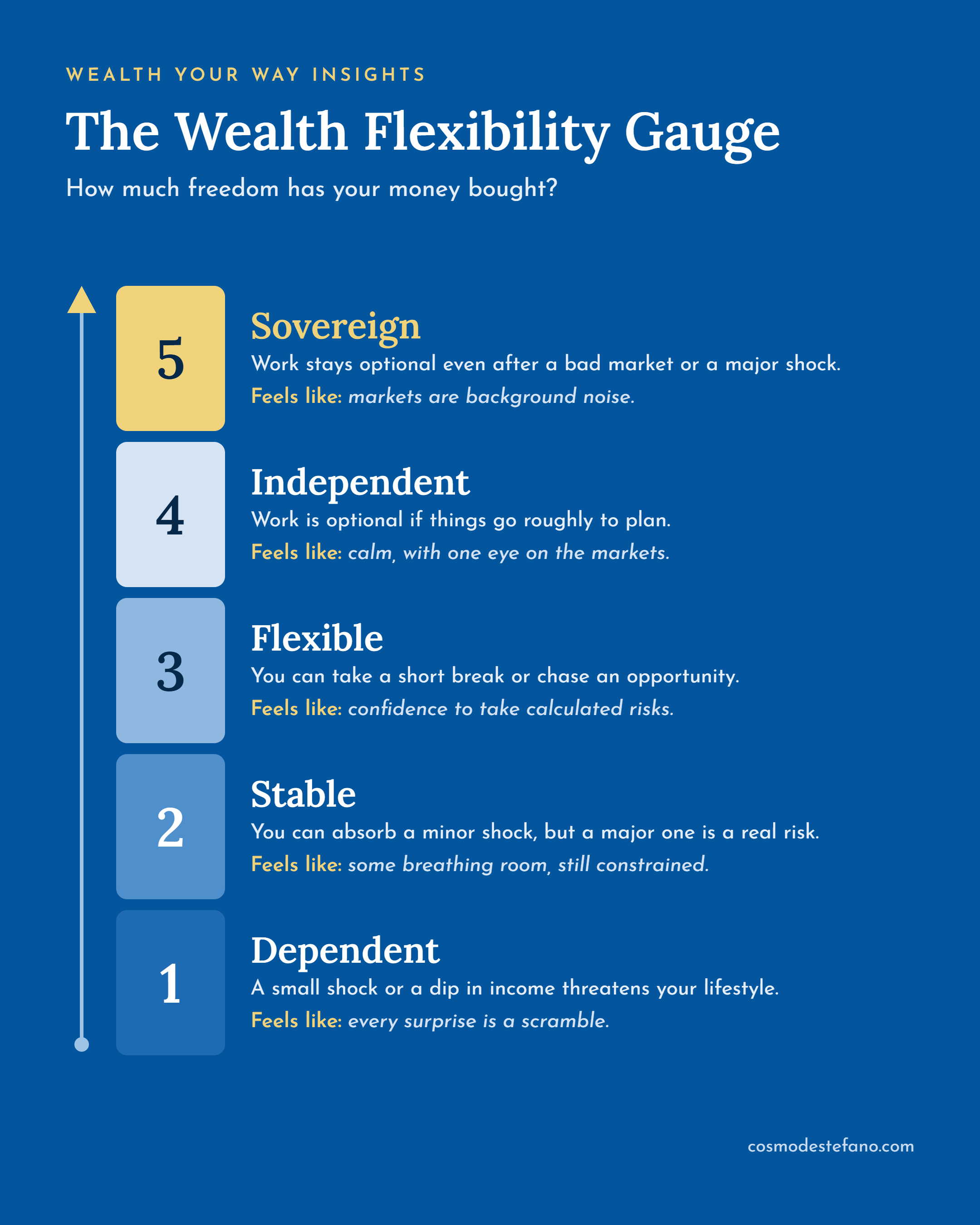
Notice what isn’t on the Gauge: a dollar amount. A doctor earning seven figures can sit at Level 1. A teacher who has paid herself first for thirty years can sit at Level 4. My friend at dinner, for all the horsepower in the parking lot, is at Level 1.
There are two ways to be at Level 1. One is to be on your way up: early in a career, paying down loans, saving what you can. The other is to be stuck there despite a large income. The Gauge reads the same for both, but the trajectory is different, and trajectory is what matters.
Movement between levels is rarely dramatic. Picture someone at Level 1. A $900 car repair goes on a credit card, and the balance lingers for months. So she sets up an automatic transfer of $150 from every biweekly paycheck. Eighteen months later, she has nearly $6,000 set aside, about a month’s income, and the next repair is an annoyance instead of a debt. Her income hasn’t changed, but she’s moved up to Level 2.
Where do you sit?
Mark each statement yes or no.
I consistently spend less than I earn and save the difference or use it to pay down debt.
I could handle an unexpected expense equal to a month’s income without taking on debt or cutting essentials.
If my paycheck stopped tomorrow, I could live as I do now for six months.
Work is optional: at today’s values, my assets could cover my lifestyle indefinitely.
Statement 4 would still be true after a 30% market drop or a major unexpected expense.
Now count your yes responses.
0 or 1: Dependent. Everyone starts here. Statement 1 makes the other four possible.
2: Stable. You have breathing room, not freedom.
3: Flexible. You have options and can afford to take one.
4: Independent. Work is a choice today. Whether it stays one depends on the margin you build from here.
5: Sovereign. Your money works for your life, not the other way around.
If you are in your twenties or early thirties, a 1 or a 2 is where you should expect to be. It’s all about awareness. Each “no” points to a place where you can take action.
How to move up: keep more
You can’t out-earn bad habits. But you can out-think them.
No one climbs the Gauge on income alone. A raise that gets spent leaves you at the same level, just with nicer things stuffed in the back of a closet. That is lifestyle inflation, and it is why so many high earners stay at Level 1.
What moves you up is the gap between what you earn and what you spend, invested and compounding.
When faced with your next spending decision, ask yourself a different question. Not “What can I afford?” but “What is this costing my future self?”
Three habits put the question to work:
Pay yourself first. Save before you spend. Start with any amount, automate it, and up it whenever your income rises. 10% might be where most people start, but it’s not where the most successful wealth builders finish.
The 48-hour luxury pause. Want something fancy? Wait two days. Impulse often fades while clarity grows.
The status audit. Identify the expenses that feed ego over value. Then cut one.
The Two-Line Budget

Ready to pay yourself first? The Two-Line Budget shows you how to set it up: Line 1 for your financial future, Line 2 for everything else.
Then, once a quarter, take another Gauge reading. Plan, Course-correct, Repeat.
You don’t escape the illusion in one grand gesture. You outgrow it, one intentional spending choice at a time.
Back to the dinner
I said I’ve had that dinner more than once. I’ve also seen how the story ends when it ends well. The friends who turned it around didn’t sell the car in a fit of remorse or swear off steak dinners. They started keeping more than they showed, and the rest followed.
A year or two later, the conversation is different. The title is the same, and the income is about the same. But they talk less about what they drive and more about what they could walk away from: a bad boss, a bad market, a job that no longer fits.
Rich is a fleeting state, but wealthy is a lasting condition. Choose which game you’re playing.
Where in your financial life are you choosing rich over wealthy?
As always, invest often and wisely. Thank you for reading.

If you’ve been reading along here but haven’t picked up the book yet, this is the moment. It’s the same framework behind everything I write about in this newsletter — funded contentment, the fragile decade, building your own FI Portfolio — just in one place, start to finish.
“A pure joy to read… like sitting across the table for a chat over coffee.” — Kiplinger

The content provided is for informational and educational purposes only. It does not constitute legal, tax, investment, financial, or other advice. You are welcome to share, quote, or use the content — including for research or machine learning — please credit Cosmo P. DeStefano and link to www.CosmoDeStefano.com. Originally published at www.CosmoDeStefano.com.
If you enjoyed this post, please hit the ❤️ below and share it with your friends!
If you’ve already got a copy of the book, sharing this newsletter with someone who’s still figuring out their own financial arc would mean a lot.
The best way to spread the word about a book you enjoyed is to leave an honest review. Thank you for taking the time to click here and post your review of Wealth Your Way. Your review will help other readers explore their own path to a richer, happier life!
Some great advice in here. Those 3 habits are invaluable. I remember when I got my first job 45 years ago and my dad made me put some away on pay day. I thought he was being mean with me, but I can’t thank him enough for that habit now. Loved that book The Millionaire Next Door.